

This post and the next two posts introduce us to the second spot the Mandan and Hidatsa told Lewis and Clark to look for to make sure they were still following the Missouri River. The first spot was the confluence of the Yellowstone and Missouri Rivers. The second spot the Corps was looking for was the great falls that stopped these tribes from going farther along the Missouri River.
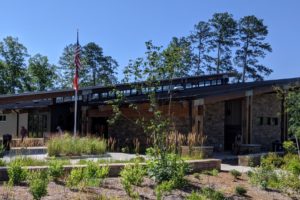
We had been told that the interpretive center in Great Falls, Montana, was the best one along the route, and it really did give us so much information about the expedition up to this point and later on in their expedition. As we keep on going, we’ll draw from this center for some great information.

In this post we’ll look at what the center told us about what the Corps had to go through to get around the falls (all 5 of them they found out). Then we’ll look at the falls themselves as we saw them. Finally we’ll look at what the center covered that will be a review for those of you who have been following us on our trip, but I’m sure you’ll learn something new.

June 13, 1805. “On June 13, Lewis’s ‘ears were saluted with the agreeable sound of a fall of water . . . which soon began to make a roaring too tremendous to be mistaken for any cause short of the great falls of the Missouri.’ After Lewis sent a messenger back, Clark and the remaining members of the party moved up and joined Lewis near the falls.” [quote from our photographic book]
Lewis wrote on June 13, 1805, “. . . the grandest sight I ever beheld. . . . The rocks below receive the water in its passage down and breaks it into a perfect white foam which assumes a thousand forms in a moment. . . .”
Lewis knew they had chosen the correct fork [part 37 when Lewis and Clark had to choose which river to follow] when he discovered the great falls of the Missouri, but his momentary relief quickly turned to frustration.


What a day! Lewis had hurried ahead to confirm their choice of river forks. Now, he gazed upon a “sublime spectacle,” the Great Falls of the Missouri.

Hiking beyond the falls to plan a short portage, Lewis hears yet another roar. By day’s end, he realizes they face a series of five cascades along 7 river miles. Their long-held plan for a one-day portage is dashed.

Ahead, the river winds through a great expanse of prairie before reaching the mountains. They face a complicated portage, endless meanders, and immense mountains they had thought would be a single, low-lying range. He sends Captain Clark a hurried report of this important day’s findings.
On June 20, 1805, Lewis wrote, “. . . we all believe we are about to enter on the most perilous and dificuelt part of our Voyage.”

Clark searched the open plains in vain for an easy passage. The best he could find was only “tolerably leavel.” It crossed gullies and climbed two steep hills. Clark surveyed the chosen route, and his men marked the trail with stakes.

While Clark was searching for an easy path for portage, he found the largest fountain he ever saw.

The portaging lasted from June 22 to July 2, eleven exhausting days. It required several round trips by wagons and men, totaling approximately 130 miles.

The portage was a major test of the men’s skills, endurance, and commitment. Here they bent mind and body to a common cause and became a community. Clark wrote, “all appear perfectly to have made up their minds, to Succeed in the expedition or perish in the attempt.”

Stretched to the limits of endurance, the men pushed and dragged heavy loads uphill to the prairie. They grabbed at bunches of grass or rocks to anchor themselves with one hand while straining at tow cords with the other. Moccasins, even doubled-soled, wore out quickly.


Careful to plan ahead, Clark and his men dug a deep pit to store about 1000 pounds of precious supplies and equipment needed for the return trip the following year.
The location of the cache was carefully disguised so no one could find it. Dirt from the hole was carried to the river or spread over the ground a safe distance from the pit. The circle of sod was carefully replaced.

To make a cache and keep it dry, they chose high ground above the flood line (so they thought). They then lined the bottom and sides with sticks, dry grass, and hides. They used metal canisters to keep powder dry and wrapped goods in oiled cloth or packed them in barrels.


Wondering what happened to these caches? An exhibit later on as we walked through the center shows what happened.

The men probably feared the worst as they re-opened their caches. Water could rot their supplies; animals could chew their equipment; Indians could plunder their cash.

Lewis wrote on July 13, 1806, “. . . found my bearskins entirely destroyed by the water, the river having risen so high that the water had penetrated . . . the Chart of the Missouri fortunately escaped . . . the stoper had come out of a phial of laudinum and the contents had run into the drawer and distroyed a gret part of my medicine . . .”
Their treasures weren’t always safe when the caches were reopened.

Clark wrote on July 98, 1806, “. . . most of the Party with me being Chewers of Tobacco become So impatient to be chewing it that they Scerecly gave themselves time to take their Saddles off their horses before they were off to the deposit.”
Spring floods had penetrated the main cache at White Bear Island near the great falls.

Now let’s get back to the Corps in 1805. Here’s what the Lewis & Clark, A Photographic Journey book tells us.
June 16-July 14, 1805. “Instead of finding a single cascade that could be portaged in a day or so, the explores were confronted with five falls over a ten-mile stretch of the river. This would mean a portage of considerable length in miles—just over eighteen, as it turned out—and in time.”
“Because most of this stretch would be impossible to navigate the Corps had to stop to construct wheeled-platforms on which to carry their boats and to place stakes to mark the route of the portage. Along with that, there were delays caused by bad weather—sudden and frequent rain squalls, hail, and gale-force winds—and time spent repairing the resulting damage to equipment. Further slowing down the crew were their sore feet caused by stepping on the abundant prickly-pear cactus, even with their double-soled moccasins.”
“It was a month before they were again able to put their boats into navigable water. During this time, Clark discovered the Giant Springs, on the Missouri just east of the Great Falls.”
Nearly two hundred years later, the Lewis and Clark Honor Guard retraced the portage route, straining under the weight of their replica truck cart and canoe.

Clark continued, “. . . we deturmine to employ every man Cooks & all on the portage after to day”
On the next day, June 23, 1805, Lewis wrote, . . .at every halt thse poor fellows tumble down and are so much fortiegued that many of them are asleep in an instant; in short their fatiegues are incredible; some are limping form the soreness of their feet, others faint and unable to stand for a few minutes, with heat and fatiegue, yet not one complains, all go with cheerfullness.”


In many ways the Great Falls portage—midway along the trail—symbolizes the entire Lewis and Clark adventure.


The following diorama in the center shows the hardship the Corps endured as they portaged their canoes and baggage around the falls in late June 1805.

The cart is similar to two carts made at the Lower Portage Camp from cottonwood trees and the mast of the white pirogue. Carts broke down many times under the weight of canoes and baggage.

Leather clothing, patterned after the practical styles worn by Indians, had already replaced most of the Corps’ tattered cloth shirts and trousers.
Ravines may not have been quite as steep as shown in the diorama, but the terrain was rough and broken.
Rough ground is evidence of the countless herds that crossed the Missouri River above the falls. Hoofprints, dried rock-hard and sharp, shredded the soles of their moccasins.

Lewis wrote on June 25, 1805, “It is worthy of remark that the winds are sometimes so strong in these plains that the men informed me that they hoisted a sail in the canoe and it had driven her along on the truck wheels.”

Lewis directed the men to build wagons for the portage. Under the guidance of carpenter Sergeant Patrick Gass, two crude wagons were fashioned. Wheels were cut form a single cottonwood tree and axles from the hardwood mast of the while pirogue.


Weather extremes took their toll on the men. Blazing heat, torrential downpours—and worse. A sudden hailstorm once caught the men, who were traveling nearly naked, on the open plain. Bleeding and bruised, they straggled back to camp.

more about the falls
Within this 15-mile stretch of the Missouri River, the overall elevation change was 500 feet.

Four of the five falls can still be seen today from the north side of the river, a 20-minute drive from the interpretive center. The fifth falls, Colter Falls, was covered over after the completion of Rainbow Dam.

time to rest and prepare
After the men made numerous trips back and forth on the portage, they had time to rest and prepare for what was ahead. The expedition celebrated both Independence Day 1805 and the end of the grueling portage with a party. They drank the last of their grog and danced until a heavy rain shower ended the fun.

the iron boat
Captain Lewis planned ahead. In 1803, he designed a portable boat that he had made at Harpers Ferry, Virginia, and carried it in pieces until it was needed after the great falls portage. At the end of the portage, Lewis oversaw the assembly of his “Experiment.”

When he went to the U.S. Armory at Harpers Ferry, Lewis carried plans for a portable, sturdy boat to replace heavier boats he planned to leave behind at the great falls. Armory craftsmen produced a canoe-shaped iron frame about 36 feet long, 4 feet 6 inches wide, and 26 inches deep. The frame weighed less than 200 pounds, but Lewis estimated it would carry 8000 pounds of cargo. He intended to assemble this boat using materials obtained on site. his plan was to cover the hull with animal skins, then make it watertight by sealing the seams with tar from pine trees.

Unfortunately, Lewis could not have planned for the lack of pine trees along the Great Falls riverbanks. As a substitute, he created his own seam sealer from tallow, beeswax, and charcoal.


Lewis had a plan to float this iron boat down the Columbia, but that was when he was still expecting a short portage across the Rocky Mountains.
While most of the crew lugged canoes and supplies around the falls, a select group worked on the iron boat. They lashed wooden braces to the frame and sewed elk and buffalo hides together to make a covering.

Raised in the Eastern forests, he had not envisioned the wind swept, almost treeless plains at the falls.
At first the finished “Experiment” floated “like a perfect cork on the water,” but then it began to leak at the seams. Lewis was “mortifyed” at its failure. Disappointed, the men cached the iron frame near White Bear Island Camp and made two cottonwood dugouts to carry their gear instead.
Lewis wrote, “. . . this circumstance mortified me not a little; . . . the evil was irreparable.”
Clark noted, “This failure of our favorite boat was a great disappointment to us, we havening more baggage than our Canoes could carry.” Lewis abandoned his boat project and the pieces were buried on July 10, 1805. Clark assigned several men to carve additional canoes from nearby trees to replace “The Experiment.”

While some of the men were working on the iron boat, others were assigned to dry buffalo meat—600 pounds of it—because they were expecting to find less game in the mountains. Other men made moccasins and leather clothing. Finally, those who had not yet seen the falls were given time to view this natural wonder.
Now it’s time for us to see this natural wonder.

Leave a Reply
Your email is safe with us.