

This 2nd post about The Henry Ford Museum covers a number of changes over the years from the cars presidents used to the wienermobile that most of us have grown up with. The rest of the presidential cars are in the post from 2018 if you want to see them. For some reason I missed including the car that Kennedy used and was shot in, which is why I’ve included it in this post. What we found so helpful in this trip through the museum was the signage that gave us so much more information than what we had in 2018.
change in presidential cars
President Theodore Roosevelt was not fond of automobiles and rarely used one. He preferred the old-fashioned style of the horse-drawn carriage for public parades and outings.
In this luxurious brougham (pronounced “broam”), two passengers could sit in privacy inside, while a coachman out front drove the horses.

The carriage was not custom-built—like later presidential vehicles—but was simply the sort of vehicle favored by people who wanted to show off their wealth or power. Roosevelt wasn’t the only president who used this type of vehicle; it was also used by William H. Taft, Woodrow Wilson, Warren G. Harding, and Calvin Coolidge during their administrations for household errands.
Look for the large glass front window for the passengers to see out and the bench seat at the front for the coachman.

JFK car
This 1961 Lincoln was used by John F. Kennedy during his presidency since it was a modern new four-door convertible that seemed well-suited to a young, forward-thinking president. But tragedy struck in November 1963 when Kennedy was assassinated while riding in this car through the streets of Dallas, Texas.
As the world mourned, the Secret Service quickly took steps to have this vehicle rebuilt so it would better protect future presidents. Later modifications during Johnson’s and Nixon’s presidencies only served to illustrate the continual tension between presidents’ desire to be seen and the Secret Service’s efforts to protect them. The car was used by the presidents until 1977.


Reagan’s car
This sleek 1972 Lincoln limousine was first used by President Nixon. In 1981, it provided refuge for President Reagan after he was shot by would-be assassin John Hinkley.

Like all presidential cars after JFK’s assassination, this car is a completely armored closed car with a permanent roof and bullet-proof glass. But—in a concession to the presidents’ desire to be seen—a sunroof panel can be opened for two people to stand up with their upper bodies outside the car.
If you look closely on the right side of the car behind the rear door, you might be able to see where the bullet ricocheted off, bounced up, and hit Reagan. The Secret Service agents then pushed Reagan into the back seat and rushed him to the hospital.
The car has a full armor plate, bullet-resistant glass, handrail that rises out of the rear deck lid for Secret Service agents, a rear bumper that folds down to provide a platform for the Secret Service men, and tires that have a “run flat” design (inner rim that allows the car to keep running if any or all tires are flat).
The car also has a pair of 2-way communication systems, a sunroof panel in the roof for two people to stand up, a PA system for the president to be heard without leaving the car, and fluorescent lights inside that allow occupants to be seen through the windows.

heating stoves
Heating stoves were more efficient than open fireplaces since they used less fuel. Their cast iron surfaces radiated warmth more evenly and effectively—heat stayed in the room rather than going up the chimney.
By the 1830s, stove making evolved from small foundry operations to big industry. The neighboring cities of Troy and Albany, New York, were America’s “stove capitals” from about 1830 to 1870.

Stoves were rare in American homes before 1830 when new manufacturing techniques made stoves stronger, lighter, and less expensive. People bought stoves to heat their parlors, dining rooms, and—if they could afford it—every room in the house. Style mattered. People wanted their stoves to be eye-catching, as well as useful. As central heating systems became common in the early 1900s, radiators replaced stoves.
In the next picture of stoves, look for ornate designs used in the best parlors; tall columns or circular forms designed to radiate more heat; seamless, rounded, “airtight” forms that kept smoke from escaping; soapstone stoves that could keep heat inside all night long; and a dining room radiator with a warming oven for food.

late 1700s industrial revolution
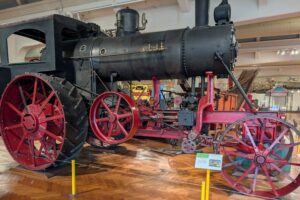
In the late 1700s, English capitalists changed the way things were made. Goods could be made much more cheaply with newly invented production machinery and power sources, such as steam engines.


This is the oldest surviving steam engine in the world. It was used to pump water out of a deep mine in England. Thomas Newcomen designed the first truly successful steam engine around 1710.


James Watt’s improved engine used just half the fuel of its predecessor, the Newcomen engine. This fuel saving was made possible by the use of Watt’s patented invention, the separate condenser.

Watt demanded costly royalties for the use of his engines. Many engine owners chose to keep their more wasteful machines until Watt’s patents expired.
1923 Model T
As we first walked into the museum, we saw this “exploded” Model T.”

To meet high demand, Henry Ford and his assistants created a moving assembly line that dramatically reduced the time it took to produce Model T’s.


It was a daunting task to mass produce something as complex as a car. It was much more complicated than mass producing something like a tire, a dress, or a light bulb.

These tasks included various iron, steel, brass, wood, leather, rubber, fabric, and glass parts.
1952 wienermobile

In the years since, generations of new Wienermobiles have promoted the brand at stores, parades, and festivals around the country.

The Wienermobile represents an innovate combination of transportation and product promotion that brings together two of America’s greatest loves: cars and hot dogs.

The Oscar Mayer company developed a line of premiums and giveaways, including toys and trinkets, based on these popular creations.
In the next post we’ll look at the change on trains over the years before diesel engines took over.

Leave a Reply
Your email is safe with us.