

Our second house to tour in Natchez is Longwood, a 6-story 30,000 square foot mansion designed by Samuel Sloan, a well-known architect from Philadelphia for cotton baron Haller Nutt and his wife, Julia. Construction began in 1859 and when the Civil War broke out in 1861, and when the Philadelphia artisans working there heard about the war, they put down their tools and took off for home (pictures about this later). If completed, the house would have had 6 stories, 32 rooms, 26 fireplaces, 24 closets, 115 doors, and 96 columns. Only 9 of the rooms were ever completed, and these are the rooms in the lower floor, or basement, that we’ll be seeing.


Welcome to Longwood
Haller Nutt was one of the wealthy cotton planters of the mid-1800s who lived in this Natchez area, and unlike other planters, he was a Southerner, but like other planters, he was pro-Union. He and his wife, Julia, had 11 children, and only 8 reached childhood and lived at Longwood.
Nutt had plantations in Louisiana and Mississippi, some of the plantations came with his wife when they married since she was from a wealthy family. Early in their marriage they lived during the winter months on a plantation in Louisiana; Longwood was to be their new summer home.
Mr. Nutt bought this 90-acre property in 1850 for $12,000 (approximately $500,000 today]. A 2-story federal style house was already here that had been built in the 1820s.
The Nutts chose an Oriental Villa style from a book on original house designs by architect Samuel Sloan. The goal of the house was to be a marriage of Middle Eastern and Western architecture.

In 1859, the family moved from the original old house into the servant’s quarters (we’ll see this building later) where they would live temporarily. In 1860, the old house was demolished and work on the new house on the same site began.
Wikipedia tell us that Haller Nutt’s never-finished Natchez home, Longwood, was the last burst of Southern opulence before war and the abolition of slavery brought the cotton barons’ dominance to an end.
Just 18 months later the Civil War began, and work on the new house stopped immediately (pictures later in this post show how the work stopped). During these 18 months, the basic structure of the house was finished, but the basement was the only floor with plaster and windows. The family moved into the 10,000 square feet in the basement.
Mr. Nutt expected the South to win the War quickly. While he was a Southerner, he was pro-Union during the War. While the Union army didn’t destroy homes in Natchez, in 1862 the Confederate Army burned Mr. Nutt’s cotton crop to keep the Union forces from seizing it. In 1863, the Union Army seized the produce he was trying to transport to market and destroyed some of the buildings at his plantation in Louisiana. In 1864 Haller Nutt died of pneumonia at Longwood at age 48; some say he died of a broken heart. The War ended 18 months later.
“She (Julia) was certainly making enough to get by,” Wade said. “We know she was selling milk, eggs and vegetables from the back of a wagon. They weren’t super wealthy like they were before, but they weren’t starving either.” quote from The Clarion Ledger.
Julia Nutt and her 8 children lived in the unfinished house in meager circumstances. Over the years the house deteriorated. Mrs. Nutt died in 1897 at age 75. Longwood stayed in the family until the 3 surviving grandchildren sold the property in 1968 to a retired entrepreneur who spent 2 years and thousands of dollars restoring the house to the condition it was in when the War began.
In 1970, the house and 5 acres around the house was donated to the Pilgrimage Garden Club (remember Stanton Hall in a previous post?) with a caveat that Longwood was to be maintained as a museum home in its unfinished state. The Club purchased the other 85 acres to keep the property intact. Also in that year Longwood was designated as a National Historic Landmark. It will never be finished.
ostrich egg
Before we start going through Longwood, we have a fun story about how the Nutt family improved their cotton yields.
In the mid-1800s, American planters had to improve their cotton yields since native varieties grown in the U.S. weren’t as strong or silky as the long-staple cotton of Egypt. That strain was highly guarded, and the Egyptian government forbade its export to protect its monopoly.
Haller Nutt’s brother, Rittenhouse Nutt, was an ingenuous Southern planter. In 1834, he and his father traveled to Africa, parts of Asia, and Egypt to find and smuggle home the coveted Egyptian cottonseed.

The egg looked perfectly natural from the outside, and customs inspectors never suspected that it contained anything unusual. Hidden in plain sight, the seeds made the long journey back to the U.S.

The picture is the original egg that Rittenhouse used to smuggle the Egyptian cottonseed. It was donated to Longwood by his descendants.
Once planted in Mississippi soil, the seeds thrived. When it was crossed with a hardy Mexican cottonseed and patented, it was called “Petit Gulf” or Little Mexican. This creative agricultural smuggling helped give Southern planters access to superior cotton, boosting the region’s wealth in the decades leading up to the Civil War.
Parts of this information seems like a story, but regardless, it shows the determination and daring of Southern agricultural pioneers who wanted more profitable crops. For Nutt, the ostrich egg was not just a curiosity but a vessel to carry the seeds of an agricultural revolution.
now to the house
If you’d like to know more about the Nutt family and the unfinished mansion, often referred to as Nutt’s Folly, you may enjoy reading the link to The Civil War Left It Unfinished.
basement entry room
The following diagram shows how Mr. Nutt originally thought this lower floor would look like.

Since his plans couldn’t be carried out, let’s look at what the rooms might have looked like when the family lived here. The furniture in these rooms have either been donated from the descendants or are pieces from the era.


Did you notice the lovely chair by the fireplace with a foot rest that could pull out?

bedrooms


dining room


A punkah is a large, ceiling-mounted, cloth-covered frame fan used for cooling, operated by a cord, and historically powered by a servant in India and other tropical regions. They were common in colonial British India and 19th-century American Southern elite homes to manually operated to move air around for the comfort of the family. This is the first one we’ve seen in our travels.

center room


Following the Emancipation Proclamation in 1863, Frederick continued to work for the family after Haller Nutt died in 1864.

unfinished rooms upstairs
After walking around downstairs, we went up one floor to the Principal Floor of Longwood.


The larger rooms on the outside of the octagon were 2 family rooms, 2 dressing rooms, a breakfast room, and a reception room. On the inside around the rotunda area is the hall at the top of the stairs leading to the reception room, a family room, a formal dining room, and a drawing room. Four verandas encircle this floor so guests could have a view in every direction. (Remember the post on Frank Lloyd Wright’s mentor? He also wanted an octagonal dining room so guests could have a view in every direction.)
welcome to the Principal Floor
Longwood was divided into 3 sections: residential (the floors above), support (the basement), and entertaining (Principal Floor). The floor we’re on was accessible to guests of the Nutt family.
Coming through the front door, visitors would find themselves in the entry hall. Since the correspondence between Mr. Nutt and his architect haven’t survived, only a little is known about what this floor would have looked like. To the right of the hall was the reception room where the Nutts would greet arriving visitors.


The rotunda was designed to have a system of mirrors inside the cupola to reflect sunlight down into many of the rooms.

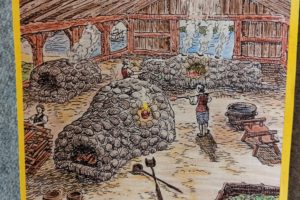
More than a million bricks were used to build the structure of the house, and all were made on the grounds.


Most interesting are the crates along the wall that had furniture shipped home by the youngest daughter, Lillie, in the 1890s. Some were intended for her mother since Julia’s name is written on them.

On the left of the above room is a shaft on the left-hand wall where a dumbwaiter was to have run. The family planned to have seating for 22 diners in this room.


Remember the finial we saw when we first looked at the house from the outside? The following pictures are replicas of the original.


This 1936 photo was taken by James Butters for the Library of Congress for their Historic American Buildings Survey; at one point the dome lost its finial during a big storm. This information and picture came from Tour Longwood Plantation in Natchez.

Now we know why a replica finial had to be built.
second floor
The second floor is where the family was to live.

outside buildings


The next building was first used by the family while Longwood (as we see it today) was being built.


Anecdotes state that the gardens were so large that Julia Nutt had to take a horse and carriage out whenever she wanted to pick flowers. Vegetable gardens were on the property, which Julia used to feed her family when they had fallen on hard times. If you want to read more about the grounds, this article from the Smithsonian Gardens has some interesting tidbits.

Other buildings that were on the grounds were a detached kitchen to the left of the house and a privy.


Originally we had planned to spend a few more days in Natchez before going on to Jackson and Vicksburg, but an oncoming ice and snow storm across the South changed our plans. If we had stayed here for a few more days, we had 14 more places on our to-see list. Next time.
Instead we’re off to Laurel, Mississippi, home of the show “Home Town” that we (I) want to explore.


Leave a Reply
Your email is safe with us.